Thursday, May 14, 2015

Mother's Day

My Experiences with Mother's Day
Every year on Mother's Day, and the few days leading up to it, my Facebook news feed gets loaded down with Thank You Mother notes. I can understand for the majority of people, this is a normal every year occurrence. I admit I never used to think of this day as something horrible and with dread. When I was growing up, I even went and made my own cards to give to my mother on this day.
One of my Mother's Day cards growing up

Then I moved from the US to Australia and I was so busy with the move, I didn't realize the day I picked, May 9, was Mother's Day. I remembered earlier that day, but between getting to the airport and my mother's "Well are we done yet? Can I leave?" mixed with with "If you get into any trouble over there I don't want to know" type of statements the statement for Happy Mother's Day just withered away along with my positive attitude on that day.

Then after we married and started to try for children, each step got a little harder during certain days and holidays. This was one of them. Now? Now, after over 15 years of trying to have children, and still no live birth, during these days, I just try and stay away from anything to do with the day because I do understand people being happy about it, but it just makes me feel like crap and a loser as a woman and wife.

How Genealogy helped me
In saying this, I was grateful this year too. Huh? How can you still feel like crap and a loser as a wife and woman?

This year I found ancestors - past women - who I am related to and am thankful they were so strong and together have made me who I am. If these women didn't have the courage and guts then I wouldn't be who I am today.


My Mother
My mother and I

My mother is very strong. Back when she gave birth to me, my father, who was in the US Navy, was out to sea when she went into labor. She was helped by my paternal grandmother to be driven to West Point but then also had to deal with having 4 children at home waiting for her while taking care of a newborn (me). This is the woman I am named after - only because she lost the bet and I'm a girl.

My Maternal & Paternal Grandmothers
My Paternal Grandmother
My Maternal Grandmother

Both of these women were very strong and brave. 
My paternal grandmother, Jean/Geneowfa, who was in my life until my teens, survived Russia, Poland during WW1 and the fighting before WW1. Later, she moved to the US at the age of 10 and learned English and about America. Later, she married, had children, and owned businesses in Newburgh, NY. Everyone loved and respected her and knew better than to try and take advantage of her.

My maternal grandmother, Janet (whom I'm part named after), I only had met a few times in my life. She was born in Pennsylvania,USA. She had many brother's and sisters, but sadly lost a few siblings before they turned 5 due to diseases. Later, she met my grandfather, married and moved to New York to be near his family. They struggled as employment wasn't the best, but she always had her mother and sister's nearby in Newburgh, NY.

My Great Grandmother's
Maryanna Ślepowron Wojtkowska


Geneowfa/Jean's mother was Maryanna. She grew up in Russia Poland among fighting and unrest. However, she married and had my grandmother while going through this. Then her husband went to the US while her and my grandmother stayed behind. After World War 1, they were finally able to leave Russia Poland on the last ship out before they closed the boarders. She arrived in the US without knowing how to speak the language and had to go through a short interview before being allowed into the country. Once inside, she was able to find relatives and set up a life for her and her family.



No known picture of Anna Klepperich
My paternal great grandmother was Anna Klepperich. She was born in Germany. I'm still looking for information on her.


No known picture of Bronislaw Ostrzycki Jagodzinski
 My maternal great grandmother was Bronisława Ostrzycki Jagodzinski. She, too, was born in Russia Poland, but left with her father and some siblings when she was around 14 years old. Her father changed her name to Bridget when they first arrived. However, when her and her husband split, she then changed her name to Bernice and moved to Newburgh, NY to be near her daughters. 


Ane / Annie / Anna Hansine Larsen Gauquie
My maternal great grandmother was born as Ane Hansine Larsen but was known later in life as Annie Larsen Gauquie. She was born in Alrup, Denmark. By the time she was 17 she was a servant on a farm like her brother and had no mother, father or grandmother. At the age of 19, she left Denmark for St. Paul, Mn.in the USA. When she was 24, she met her husband and moved to NY where she was a dairy farmer's wife and mother. She lost one child to drowning and another caught Polio. She milked cows and was even known to been injured by them. She was very loved and well thought of in the community. 


My 2x great grandmothers


No known picture of Hansine Emeline Nielsdatter
My maternal 2x great grandmother of Ane (or Annie), was Hansine Emeline Nielsdatter of Denmark. I am still
researching her but I do know she was 42 years old when she passed away according to documents I had found so far.


No known picture of Florentina Van Rompaye
My maternal 2x great grandmother of Joannes Julius was Florentina Van Rompaye Gauquie of Wiekevorst, Belgium. She was a very strong woman as she was a servant when she met her future husband. She got pregnant and was let go of her position, so lived with her widowed brother in-law when she had my great grandfather Joannes Julius. My 2x great grandfather was drafted into the service and it wasn't until he returned home after serving that he found he had a child. Unfortunately, I do not know where she died or is buried.


Walerja (Valerie) Rutkowski Ostrzycki
Another of my maternal 2x great grandmother of Bronisława Ostrzycki Jagodzinski was Walerja (Valerie) Rutkowski Ostrzycki. She was born in Russia Poland where she married and had children.
In fact, when she was 16, she knew who she wanted to marry, but needed special permissions. After going to the church 3 times for bann's or released in the church, her parents finally relented and let them marry. After she had children, the whole family (herself, husband and children) all left Russia Poland for Pennsylvania USA. Where she worked in many positions (including nurse) and lost her 3 youngest children to diseases. She ended up dying from Hodgkin's Disease.

Other Notable Women

On my maternal Jagodzinski's side, I do not know any further information.

On my paternal side, I do not know any further information.

I do have other great's I can go back to but there's only a few lines I can go back that far unfortunately. However, I am still not done looking...and learning.

These are the women that made me who I am, even though I have never met some of them. Each one, a you can see, had a strength in their own way to be proud of and I am proud of them and to be a related to them. If they could do what they did their much different world than what we know of today, then I can surely do the same in today's world. These women give me strength and courage to go on and try things I never would have otherwise.


In fact, I think the women's restroom sign is correct - that its NOT a dress - when you look at this strong line of women I come from.
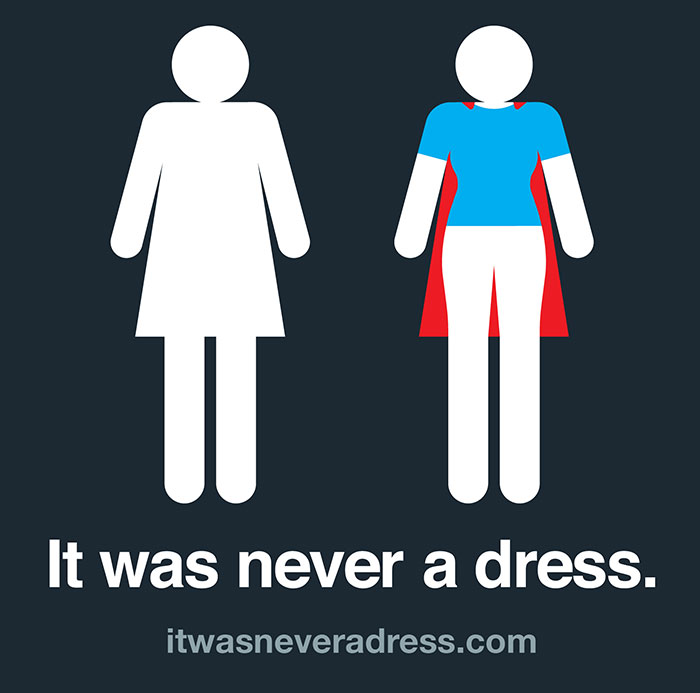
 
Taken from http://static.boredpanda.com/blog/wp-content/uploads/2015/05/bathroom-sign-gender-equality-it-was-never-a-dress-tania-katan-1.jpg
To go through what these women have all gone through, they must have been super women.

Tuesday, March 31, 2015

Centenary celebrations of WW1 in 2015 - What about Leper/Ypres?

To me, World War 1, was in 1914. However, Australia is celebrating the centenary in 2015 with the most known about part being the Gallipoli landing in Turkish Thrace, which was just a disaster for the Australians. 

Taken from australia.tourismster.com
Each year on April 25th, we go into Melbourne city to the Shrine of Remembrance. I remember the first few years we did this I didn't really understand as I was new to the whole thing. Then I became educated about it and about how everything happened. Then I would sit and think about what my mother's cousin, Jimmy, went through when he died in World War 2. 

Then in 2014, I started to learn more about my family through researching my family history. I found we just didn't have a few people - it was starting to become quite a list between current people that were serving, people who had retired, and then back to those who had fought for their countries independence and not survived. It had humbled me. 
My 2x great grandfather's National Military certificate which says he was the 8th person "drafted"

Then this year, I found my 2x great grandfather was actually drafted into the Belgium army. It was the first time it had actually been used (since it came into law in 1830) and this was back in 1865! Then I got to thinking...in World War 1 (1914-1918) what did my great grandfather's cousins, who were still in Belgium, and their families actually go through during that war? 

I then put on my detectives hat and went searching....
Taken from the website imgbuddy.com

The part of Belgium I'm talking about is in the region of Flanders. This area is actually quite known, especially in Australia, due to the poem of In Flanders Fields which has been brought up many times since I've been here. However, I didn't realize that the Flanders they were talking about is actually my ancestor's homeland. 
From kstevensblog.wordpress.com
Where my ancestor's came from was around the Leper (Ypres) area. I was shocked. I then asked myself those who stayed behind, what did they go through during World War 1? 

Apparently right where my ancestors came from was the Western Front and there were MANY battles over and over again in this area with artillery and infantry advances. I had heard of the Battle of Verdun from hubby's family history and Battle of the Somme from my father in-law talking about him wanting to go and see that area and not realizing that's where my family actually came from as far back as the early 1700's. 

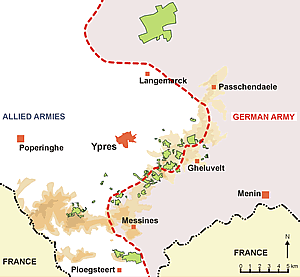
The Front Line (red dashed line) stabilized east of Ypres, forming a salient in the Allied Armies' Front Line at the end of the 1st Battle of Ypres by 22nd November 1914 taken from website http://www.greatwar.co.uk/ypres-salient/index.htm
Again I ask myself - what did the people who lived there - like my ancestors cousins - go through during this time? 

Well first the Flanders area was taken over by the British Army which made it the home base for them. However, a small area around Ypres remained under Belgian control.
Wikipedia says:
Many civilians fled the war zones to safer parts of Belgium. Many refugees from all over the country went to the Netherlands (which was neutral) and about 300,000 to France. Over 200,000 went to Britain, where they resettled in London and found war jobs. The British and French governments set up the War Refugees Committee (WRC) and the Secours National, to provide relief and support; there were an additional 1,500 local WRC committees in Britain. The high visibility of the refugees underscored the role of Belgium in the minds of the French and British. [6][7] In the spring of 1915, German authorities started construction on the Wire of Death, a lethal electric fence along the Belgian-Dutch border which would claim the lives of between 2,000 to 3,000 Belgian refugees trying to escape the occupied country.[8]
Ypres Ruins; Ypres 1915 take from www.toerisme-ieper.be
How would that have been? Conflict arriving on your doorstep and you have to take your family and just run where ever you could flee. There was no place to escape as you can see by the picture above. Wikipedia goes on to say
There was a firm belief that the Belgians had unleashed illegal saboteurs and that civilians had tortured and maltreated German soldiers. The response was a series of multiple large-scale attacks on civilians and the destruction of historic buildings and cultural centers. The German army executed between 5,500 and 6,500[11] French and Belgian civilians between August and November 1914, usually in near-random large-scale shootings of civilians ordered by junior German officers. Individuals suspected of partisan activities were summarily shot. Historians researching German Army records have discovered 101 "major" incidents—where ten or more civilians were killed—with a total of 4,421 executed. Historians have also discovered 383 "minor" incidents that led to the deaths of another 1,100 Belgians.
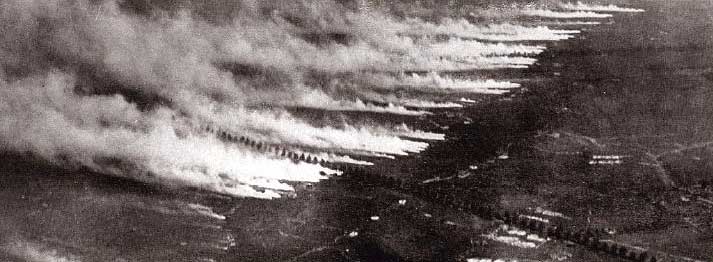
This reminds me of the Polish people and how they had to keep fleeing in order not to be persecuted except instead of the Russians, it was by the Germans. Further, the Flanders region was the first region to actually have the poison gas used. I cannot imagine people dying because of a gas they didn't expect was used. That would have been horrible.

Gas Attack During the Second Battle of Ypres take from www.huffingtonpost.com
Now I know about what my family and cousins would have went through, I now have something else to think about this Anzac day when people talk about The Great War and when someone reads out "In Flanders Fields" because it was just something that happened to people - it happened to my family.

Now when plan to visit the battlefields, we'll actually be in the area of my ancestors.


In Flanders Fields (1921) title design.png from commons.wikimedia.org

There are many different websites out there for this area...
Belgium in World War 1
Western Front Association
Flanders Fields 

This Anzac day or when you think about World War 1, think about those families who lived and died on the land before the fighting broke out. Remember they were once someone's ancestors too. 

Monday, March 23, 2015

Happy National Puppy Day!


National Puppy Day is held on March 23 to celebrate how much joy puppies, and pets, bring into our lives. Think about your life - can you remember pets growing up? Do you have pets now? Think about the time they brought joy and felt you need to be hugged and cuddled after a really bad day. This day, which started in 2006, is to celebrate those creatures big and small who have been there for us.

Now think about your family's history - do you remember having pets growing up? Can you remember they way you felt around them?

I know throughout my life, I've had a wide range of animals growing up - many cats that have "shown up" at the door, puppies that were given to us, and later us going to buy them from either people selling them or from the RSPCA and rescued the pets. When I think back, they are some smiles and laughter of joy, or a sad smile in remembrance of them. Take the time out today to think about those pets who meant so much to you then and now.

Here's some of the pets I had growing up....
About 1977 Me with some Boxer Pups

1970s My husband's cat trying to catch the water dripping

January 1980 Midgie 

Jan 1982 Brute
1997 Kane - my brother in law's dog when I moved to Australia
1991 June Alfy on his back in our Maybrook Apartment


2003 - This is JR and Jackie play fighting outside.


2004 - Buddy and Jackie on Buddy's first day at home.

2012 Buddy all ready for Christmas
There are many other pictures and videos we have, but either they are not with me at the moment or they've been lost. 

As you can see, each pet has a different personality just like humans. Do you know what pets your ancestor's had? You might want to make note of stories and pictures. For instance, we had a grandmother, I think, that kept a chicken in the kitchen sink in the 1950's. From what I've found, this is or was common in Poland.

Monday, March 9, 2015

Take a journey with your ancestors...

I have to say, in the years that I have been doing my family's genealogy, I never know where I am going to go on a given day if something arises when I am doing research. In fact, I've told both people I have spoken one on one with and groups, that when you do genealogy you just hang on for the ride. The research will take you were you are meant to go.

The FindMyPast Free Weekend

For instance, this past weekend FindMyPast had a free weekend from Friday night until Monday night in Australia.

On Friday night/Saturday morning, I was in the US finding out about Gauquie's there. I went to states like New York and California.

On Saturday I went in search of people/places in Newburgh, New York and Germany. Sunday was a big day - I went in search of the Ostrzycki's. This was in New York, Pennsylvania, Tennessee, Alabama, Georgia, Washington DC and some other places. It seems once the original ancestors that came over from Poland, once they were gone people started to move out into the rest of the US. I learned about some who were hurt by accidents, illnesses and some who had died. Some that looked up to others and some who moved to help family out. In fact this was so big it took over most of my Sunday as well.
Lon Ostrzycki (@PastorLonO) on Twitter
"...He was my hero and I wanted to follow in his footsteps. ...He was not going to be counted out in the game of life and has exhibited the same persistent qualities I watched him display on the football field in his fight to walk again" - Lon Ostrzycki about his brother Wayne in September 21 1985 Monessen Valley Independent story, page 5.
Monday came and I started to do country searches to see what was happening in some of the countries. I went to Koblenz/Cobelenz Germany, Belgium, French Flanders, and France. I was looking for information on what was happening within the countries at the time to see what influences happened to my ancestors. However, most of the newspapers were either very blurred or very tiny and after a few hours I had a headache and couldn't do it any longer. If I found something I could easily read, I did, but most of it was in tiny typing which was crazy. Even my husband who said he wasn't having a hard time tried to see what he could do and ran into the same thing as myself.

What can you find out from old newspapers?

However, I did get to know my family a bit more. I know what church had the service for my great great grandmother and have tracked down where she is buried. It sounds like it was the family place
1931 Aug 24 Charleroi Mail Valerie's obit
to be buried because of some of the death certificates I have. Like I said above, I know about illnesses, accidents and birthday parties. Associations family members were in and how involved in the community they were.

I found with one of my grandparent's businesses, someone was robbed and assaulted just after they bought the business and it was right next door! From the way it was written, I think my grandmother already had an impact because instead of starting anything in the business, they went outside. I smiled at that one!
1946 Jan 17 Middletown Times Herald

Then I learned that another family member sold up his livestock because of an illness. I know he must have won that time against the illness because he lives near the Great Lakes and is a farmer. He has a daughter that is going to be or is a vet as she was on the Dean's List a few years ago. I know another Grand Uncle lost his barn in a fire and said he would have to either sell his livestock or rebuild the barn but he couldn't do both. Tough times all around, but there were good times too. We had a Valedictorian and Student Presidents in the family too.

That's why when you do family history, think of yourself in a canoe going down a river - sometimes its a wild ride like with rapids and other times it flat and you are just floating along. Either way, you can learn alot about your ancestors - you just have to keep your eyes open.
Picture taken from https://knoji.com/images/user/spring(1).jpg

I'm floating - how & where can I keep my eyes open? 

We all hit brick walls. What you need to do is look at different ways of obtaining the information. Some ways are:
  • Look up the surnames. 
  • Look up towns and places your ancestors lived. 
  • Look up clubs, associations, and churches they were involved with. 
  • Look up places and the above mentioned things on Facebook and join the pages.
  • If you live close enough, visit them in person. 
  • Visit historical societies and attend genealogical talks. 
  • Have you done a timeline for each your ancestors? 
  • Have you put history or events in them? 

These may all give you what your ancestor was going through. This is what we call putting flesh on the ancestor. Its almost like you are stepping back into time and looking at what they were experiencing.

Remember, not everything is online - I would say there's at least 60-50% of information that is still not online, so you have to go places or ask others to go there for you.