Showing posts with label French revolution. Show all posts

Monday, June 17, 2019

Earliest Ancestor I could find is....Ancestors in 52 Weeks


This year's challenge is 52 Ancestors in 52 Weeks and is run by Amy Johnson Crow.

Topic Info:
Some ways that you might interpret this would be the earliest ancestor you've identified or the earliest document you've found. Maybe the earliest ancestor in a specific location.

As with most people today, most of my family came over in the early 1900s from Europe. The last ancestor to come over was my grandfather, Mathis, in 1926 from Germany.

My earliest ancestor I've been able to find would be 7th generation great grandparents, Laurent Gauquie and Maria C Beun. Both of them would have been born before 1700 and are noted on others family charts, but I don't have any further documentation on them.  They are both from or lived in what we now know is Belgium, but it was once a part of France and another time Austria.

Jean Baptiste Gauquie & family
As I'm not sure about anything from those ancestor's, I will continue with my 6th great grandparents, Jean Baptiste Gauquie (1723-1772) and his wife, Isabelle Verscheave (1729-1802), and their 2 sons.

This information I have from one of my cousins who had the time to go around to the churches to get these entries due to them not being available online. Let's face it, France is a lot closer to Belgium than Australia!

According to Jacobus Josephus Gauquie (spelled Gauguy), his son's entry (below), he was from Wytschaete part of Belgium.
The church birth entry for Jacobus Josephus Gauquie (Gauquy) in 1767 including translation. 

According to the same document (above), his mother Isabella, was from Boesynghe (now Boesinge) part of Belgium.
The area they both born in with distance from France's border. Credit: Google Earth

This area was a bit of a fighting area back then as can be seen by the section of the highlighted areas below. It is one of the oldest villages in Heuvelland (the area) (credit Wikipedia). What I thought was interesting was the French used the church as a stable.

From Wikipedia. 
However, according to his wife's death certificate be was dead prior to her passing in 1809.
Isabelle Claire Verschave death entry at Church. Credit: Herve Constille with translations above.
It does not give much of what or who they were unfortunately.

This area later become a huge part of the World Wars. They are known for fighting at Messines, Mine Battle of 1917,   Ypres SalientSpanbroekmolen and various other battles. 

Anyhow, after Jean Baptiste Gauquie passes away, the French Revolution (1789-1799) happens which is also felt here due to how close they are to France.

Then Napoleon Bonaparte starts to make his way into history from 1803–1815 with the The Napoleonic Wars start.

Their son, Jacobus Josephus Gauquie, is now of age and its hard to say if he fought with Napoleon or not, but I would look at the Conscription, or Draft, in which France held.

The concept originated during the French Revolutionary Wars, particularly for the period following 16 August 1793, when able-bodied men aged 18 to 25 were conscripted. It formed an integral part of the creation of national identity, making it distinct from forms of conscription which had existed before this date.

If we take the above concept and apply it to Jacobus, then he would have been 26 years old. Yes, its one year older than the 25, but I'm sure they would have taken him for conscription without a problem. 

He does make it through the French Revolution, but dies before the end of Napoleon's time as he dies in January 1809 in Boesighe, Belgium. 

Top is original entry from the church and bottom is 2 translations.

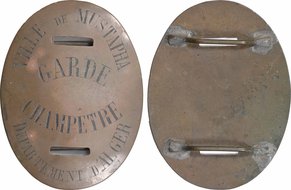
The church entry actually tells us more about who Jacobus was. He was a rural policeman or garde Champetre. Due to this, I believe he probably did serve in the fighting or Napoleon came up and gave him this job with him to report anything weird to the government. 

This is what a rural policeman or garde champetre wore. Credit
One of the badges he probably wore. Credit
Or he could have looked like this
Credit
Its also interesting that his brother, Jean-Francois Gauquie, is always mentioned in main documents and is always told as a farmer. 

Farming was in our family until my uncle Anthony Gauquie passed away a few years ago. Yes, this meant farming has been in my family for at least 250 years in some respect. Not bad at all I say. 

Thursday, May 3, 2018

A-Z Blogging Challenge - The letter F is for France!


In 2017, there was a challenge. I heard about it from jillballau blog and more information can be found out about it on the A-Z Blogging Challenge (which was at http://www.a-to-zchallenge.com/) page itself. However, as I was testing links I found the A-Z Blogging Challenge link is no longer working *frown*

Many people had done this challenge in April 2017, but I’m a rebel and do things when I have time, so I’ll do mine now. I’ve been working on it over many days, and was hoping to get it all done before posting BUT it’s taking me a lot longer than I expected. I’ll do a few posts now and work on the rest. I know I have about ½ of this challenge done in draft format, so not too bad.  J

What can I say – I’m an original. So, here I go…

The letter F is for France!

The Gauquie family has deep history in Belgium. However, way back when there was changes in the French-Belgium border. Due to this, our family in the early 1700s was on the border between France and Belgium. This included the time of Napoleon and after.

The town of Wijtschate is the red dot on the map above.
Credit
The family story was our family moved from France to Belgium because of Napoleon and the French Revolution.  As a good genealogist, you nod and say ok, and you take down the story. This includes ALL stories no matter what. Then you see what the paperwork you have balances with what history, from multiple sources say, and then you reach any number of possible conclusions. 

I thought this was a plausible story. However, when I took in the timelines of the events, Napoleon's rule from 1794-1815 and the French Revolution from 1789-late 1790s, and put them together with the paperwork from the family, it just didn't work out. 

The earliest paperwork I was able to find, thanks to a cousin, was for 1723 for my 6th great grandfather, Jean Baptiste Gauquie. It showed he was born Wijtschate, in Belgium, and died in Boezinge, in Belgium. 
If you look at the date, 1723, my relatives are already in Belgium prior to both events. However (isn't there always at but?), I was able to find something to do with Napoleon and the area.

 See highlighted parts below. 
The highlights show the area belonging to France and had been touched by Napoleon AND the French Revolution.
Credit.
The above shows stories are sometimes twisted, a tiny bit, but can also be found to have truth. I would say while, they didn't move and we're in the heart of France, they WERE part of France, and had to deal with Napoleon AND felt the French Revolution according to this above. 

This, to me, would be the reason why they left the area for Boezinge.

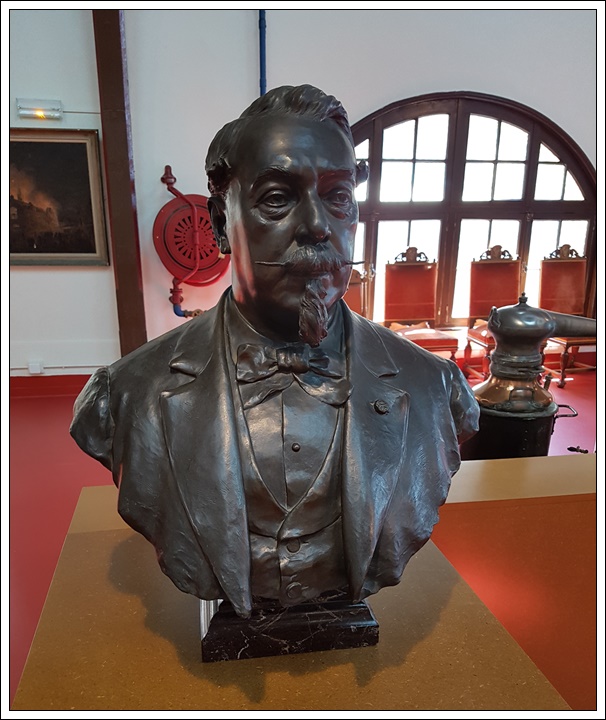
This being said, the Gauquie last name sounds very French. We do know there was a famous Gauquie sculpturer named Henri Désiré Gauquié (1858-1927). We know he’s related but we are looking into it.

A few bits of his work are below.
Credit

Credit


Credit


As if that wasn't enough, I've just learned a tiny bit of the French connection to my paternal side as well. 

Credit
My grandfather was born in a tiny town called Niedermendig, Germany and now its mainly called Mendig, Germany. 

Over the years from the 17th century on wards the border between France and Germany keeps changing. This is why many of the towns nearby have had name changes in them (exactly like Belgium).  A great example is Coblenz and Koblenz. Same place but one is French and one is German. Take a look at the map and see how close to the border it is! 


When my grandfather was born it was under German rule, but during different times it had been reverted back to France every now and then. Usually the Rhine River was the border they went to and used. 

And even here, too, they felt the French Revolution! See below.

Credit

I've only just figured this link out but thought it was very interesting and something you don't hear about during the talk of history of the two countries.


Viva la France!